

Nighttime Driving Risk rises because visibility drops, glare becomes harder to manage, and drivers have less time to recognize hazards and respond. When the environment is darker, every decision—speed, spacing, lane position, and attention—becomes more demanding, which helps explain why night driving increases accident risk.
- Why driving at night is riskier than driving during the day
- The main reasons night driving increases accident risk
- 1. Reduced visibility means less time to react
- 2. Headlight glare can reduce contrast and blind drivers temporarily
- 3. Depth perception and distance judgment get worse
- 4. Fatigue is more common after dark
- 5. More hazards are hidden in darkness
- 6. Other road users may be harder to predict at night
- 7. Rural and poorly lit roads create a bigger visibility gap
- Which types of nighttime crashes are more common?
- Pedestrian and cyclist detection failures
- Rear-end collisions
- Run-off-road incidents
- Animal strikes
- Intersection mistakes
- Why night driving can feel easier than it really is
- Practical ways to reduce night driving risk
- 1. Keep headlights clean, aimed correctly, and in good condition
- 2. Slow down earlier than you think you need to
- 3. Increase following distance
- 4. Scan farther ahead and to the sides
- 5. Reduce glare inside the vehicle
- 6. Avoid driving when you are sleepy
- 7. Be extra cautious in rain, fog, snow, and wet conditions
- How driver-assistance technology can help, and where it cannot
- Night driving habits that help on highways, city streets, and rural roads
- The role of vehicle condition in nighttime safety
- Common mistakes drivers make after dark
- FAQ: Why night driving increases accident risk
- Why is night driving more dangerous than daytime driving?
- What is the biggest danger when driving at night?
- Is rural night driving more dangerous than city night driving?
- How can I make night driving safer right away?
- Do modern car safety systems solve night driving risk?
- Should I avoid night driving altogether?
- Improving Nighttime Driving Risk with Better Awareness
- Conclusion
- Why driving at night is riskier than driving during the day
- The main reasons night driving increases accident risk
- Which types of nighttime crashes are more common?
- Why night driving can feel easier than it really is
- Practical ways to reduce night driving risk
- How driver-assistance technology can help, and where it cannot
- Night driving habits that help on highways, city streets, and rural roads
- The role of vehicle condition in nighttime safety
- Common mistakes drivers make after dark
- FAQ: Why night driving increases accident risk
- Conclusion
Why driving at night is riskier than driving during the day
Driving is a visual task, and night reduces the amount of information available to the driver. That is the core reason the risk rises. In daylight, the brain gets more detail from road markings, lane edges, pedestrians, cyclists, signs, and other vehicles. At night, those visual cues shrink dramatically.
That loss of information affects how quickly a driver can respond. A hazard that would be obvious at 2 p.m. may blend into the background at 10 p.m. A curve that looks manageable in daylight may feel sharper in darkness. A person walking along the shoulder or an animal near the road can be visible much later than you would like.
Night also tends to change driver behavior. Some people drive faster because roads are emptier. Others become less alert because the body naturally wants to sleep. In both cases, the margin for error narrows.
The main reasons night driving increases accident risk
1. Reduced visibility means less time to react
The simplest problem is also the most important: you cannot avoid what you cannot see. This is one of the biggest drivers of nighttime driving risk.
At night, headlights illuminate only part of the road ahead. Even good headlights do not provide the same wide, detailed scene that daylight does. Dark clothing, unlit vehicles, animals, potholes, debris, and road edges are all harder to detect early.
Less visibility means:
More EV News

- shorter reaction time
- later braking
- harder lane positioning
- more difficulty spotting pedestrians and cyclists
- more chance of missing a hazard hidden in shadows
A driver may still “see enough to keep going,” but not enough to respond comfortably if something unexpected appears.
2. Headlight glare can reduce contrast and blind drivers temporarily
Night driving is not only about darkness. It is also about bright light in the wrong places. Headlight glare is a frequent contributor to nighttime driving risk.
Oncoming headlights, high beams, LED glare, reflections from wet pavement, and bright instrument panels can all reduce contrast. When the eyes have to adjust repeatedly between darkness and bright light, the road can feel harder to read.
Glare can create several problems:
- temporary loss of detail after looking at oncoming traffic
- difficulty seeing lane markings
- trouble spotting people or animals near the road
- eye fatigue over longer drives
Even a brief glare event can delay recognition of a hazard just long enough to matter.
3. Depth perception and distance judgment get worse
A common nighttime problem is not that drivers see nothing, but that they misjudge what they see. Misjudging distance and speed is a key part of nighttime driving risk.
Depth perception depends heavily on visual cues that are weaker in the dark. That affects how drivers estimate:
- the speed of an oncoming vehicle
- the distance to a car ahead
- how far away a curve or junction is
- whether a person or animal is on the shoulder or in the travel lane
This is one reason night driving can feel deceptively calm. The road may look open, but the driver has less certainty about what lies ahead.
4. Fatigue is more common after dark
Fatigue is one of the biggest night-driving risks, and it is often underestimated. Fatigue increases nighttime driving risk, especially on longer trips.
People naturally feel sleepier at night, especially after long workdays or long highway trips. Even mild fatigue can slow reaction time, reduce attention, and make a driver less able to process multiple road inputs at once.
Fatigue may show up as:
- blinking more often
- drifting attention
- missing exits or signs
- slower braking
- delayed hazard recognition
- zoning out on long, straight roads
Unlike distraction, fatigue can creep in gradually. Many drivers do not notice it until their performance has already declined.
5. More hazards are hidden in darkness
Many night-driving dangers are not dramatic. They are small, easy to miss, and dangerous because of that. Hidden hazards are a major driver of nighttime driving risk.
Examples include:
- pedestrians dressed in dark clothing
- cyclists without strong lighting
- wildlife near rural roads
- stalled vehicles without enough rear lighting
- tire debris, branches, or road debris
- potholes and uneven pavement
- animals crossing unexpectedly
The darker the environment, the more likely the driver is to notice these hazards late.
6. Other road users may be harder to predict at night
Night traffic patterns are different from daytime traffic patterns. Some drivers are commuting after long shifts. Some are heading home tired. Some are unfamiliar with the route. Others may be driving too fast because traffic is lighter.
That mix can create more uneven driving behavior. It is not unusual to encounter:
- inconsistent speeds
- late lane changes
- more aggressive passing
- slower reaction from tired drivers
- more failure to notice pedestrians or roadside hazards
The result is not just lower visibility; it is a less predictable driving environment that raises nighttime driving risk.
7. Rural and poorly lit roads create a bigger visibility gap
Night driving increases sharply on rural roads, mountain routes, and streets with limited street lighting—because the gap between what you can see and what is actually out there becomes larger.
In those areas, hazards can appear with very little warning. Lane markings may be weak. Shoulders may be narrow. Wildlife may enter the road suddenly. Road curvature may hide what comes next. Even a few seconds of reduced visibility can make a significant difference.
This is why a drive that feels comfortable in the city can become more stressful outside built-up areas after dark, and why nighttime driving risk can climb quickly in low-light settings.
Which types of nighttime crashes are more common?
Night driving does not create only one type of danger. It changes the overall crash profile, which is why nighttime driving risk tends to show specific patterns.
Some of the most common risk patterns include:
Pedestrian and cyclist detection failures
People on foot or on bikes are harder to see at night, especially if they are wearing dark clothing or if their lighting is poor. The problem becomes worse in rain, fog, or when street lighting is inconsistent.
Rear-end collisions
Following distance often becomes harder to judge in the dark, especially on highways where speeds are higher. A brief lapse in attention can leave too little time to stop safely and can spike nighttime driving risk.
Run-off-road incidents
When lane edges, shoulders, or curves are not easy to read, drivers may drift too close to the edge or misjudge a bend.
Animal strikes
Wildlife collisions are a major concern on rural and suburban roads, especially where animals cross without warning or stand near the road before moving suddenly.
Intersection mistakes
At night, drivers may misread the position, speed, or intent of another vehicle at an intersection. Left turns and unprotected crossings become more stressful when visibility is lower.
Why night driving can feel easier than it really is
One reason nighttime risk is often underestimated is that traffic volume is usually lower. Empty roads can create a false sense of safety, which can make nighttime driving risk feel “manageable” until a hazard appears.
When the road looks clear, drivers may:
- speed up
- follow too closely
- reduce scanning
- become less cautious at intersections
- assume hazards are unlikely
But lower traffic does not mean lower risk. In some cases, it means the remaining hazards are less visible and therefore more dangerous.
Another reason is comfort. Some drivers simply prefer quiet roads at night. The driving experience may feel smoother, but smooth does not always mean safe. That mismatch is a common contributor to nighttime driving risk.
Practical ways to reduce night driving risk
There is no single trick that makes night driving safe in every situation. The best approach is a combination of vehicle preparation, smarter habits, and better awareness. These steps reduce nighttime driving risk in real-world conditions.
1. Keep headlights clean, aimed correctly, and in good condition
Headlights are your first line of defense at night. If they are cloudy, dim, misaligned, or dirty, visibility drops immediately—one of the fastest ways to increase nighttime driving risk.
Practical checks include:
- clean headlight lenses regularly
- replace weak bulbs as needed
- check for uneven beam aim
- make sure both headlights work properly
If your lights are too dim or aimed poorly, you may be losing visibility without realizing it.
2. Slow down earlier than you think you need to
Night driving often requires more speed discipline than daytime driving. Slower speed is one of the most reliable defenses against nighttime driving risk.
A lower speed gives you more time to:
- identify hazards
- judge distance
- respond to wildlife
- brake smoothly
- stay in lane on dark roads
On unfamiliar or rural roads, a cautious pace is usually more valuable than trying to keep the daytime rhythm of travel.
3. Increase following distance
Nighttime makes it harder to read the behavior of the vehicle ahead, especially if brake lights are difficult to spot or you are dealing with glare. More space reduces nighttime driving risk when conditions change quickly.
A larger gap gives you more time to react to:
- sudden braking
- debris
- lane changes
- stalled vehicles
- traffic slowing for a hidden hazard
4. Scan farther ahead and to the sides
Good nighttime driving is not just about looking straight ahead. It also involves active scanning, and that practice lowers nighttime driving risk.
Try to:
- look beyond the bright cone of your headlights
- watch the shoulders for movement
- check mirrors more often
- notice reflections that may indicate a person, animal, or object
- anticipate curves, junctions, and dark gaps in the road
This habit helps you detect hazards before they are directly in front of the car.
5. Reduce glare inside the vehicle
Interior glare can make an already difficult environment worse. Reducing glare helps manage nighttime driving risk by keeping your eyes adapted.
You can reduce it by:
- lowering dashboard brightness
- keeping the windshield clean inside and out
- avoiding unnecessary bright screens
- using the rearview mirror’s night setting when available
The goal is to help your eyes stay adapted to the dark.
6. Avoid driving when you are sleepy
If you are drowsy, night driving becomes much more dangerous. Sleepiness sharply increases nighttime driving risk.
Warning signs include:
- frequent yawning
- heavy eyelids
- missed signs
- drifting lane position
- difficulty remembering the last few miles
If possible, stop, rest, and continue later. No amount of confidence can fully compensate for sleepiness.
7. Be extra cautious in rain, fog, snow, and wet conditions
Poor weather makes nighttime driving risk multiply. Wet surfaces and scattered light are common causes of nighttime driving risk spikes.
Rain and snow reduce contrast. Fog scatters light. Wet roads amplify headlight glare and reflections. In all these cases, it becomes harder to judge space, speed, and road edges.
If visibility drops, it is often safer to slow down more than you normally would in daylight and avoid sudden maneuvers.
For related strategies, see Night Driving Safety in Fog: Key Tips.
How driver-assistance technology can help, and where it cannot
Modern safety technology can support night driving, but it should be viewed as assistance rather than replacement for driver attention. These systems can help reduce nighttime driving risk, but only within their limits.
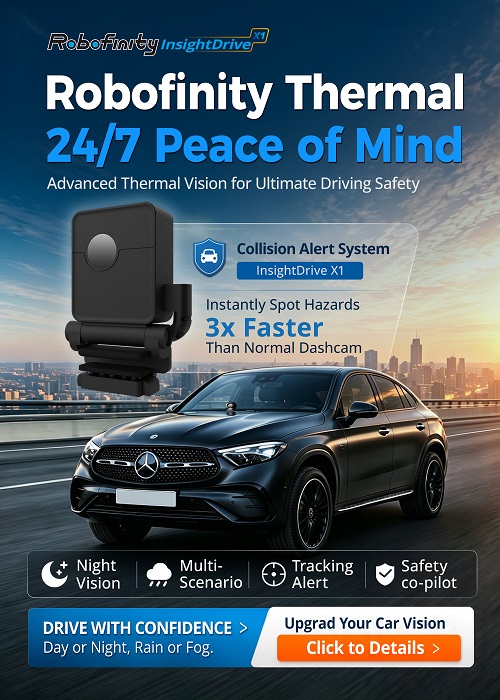
Some systems can improve awareness through alerts, cameras, lane support, or object detection. For example, drivers who often travel at night or on poorly lit roads may look into aftermarket driver-assistance upgrades such as Robofinity InsightDrive, a vehicle thermal imaging night vision system designed to support awareness of pedestrians, animals, vehicles, and obstacles ahead in low-light conditions.
That kind of technology may be useful in the right environment, but it still has limits. It does not replace headlights, mirrors, braking distance, traffic laws, or the driver’s own judgment. The safest approach is to treat any awareness system as an added layer, not a substitute for careful driving.
If you are comparing upgrades, you may also find it helpful to review Car Thermal Imaging Camera: Best Affordable Night Driving Upgrade.
Night driving habits that help on highways, city streets, and rural roads
On highways
Highway driving at night often means higher speeds and fewer visual cues. Keep your attention moving, avoid staring at a single point, and watch for vehicles approaching faster than expected. If the road feels open, resist the urge to increase speed too much—this is one of the most direct ways to reduce nighttime driving risk.
In cities
City driving at night often involves pedestrians, cyclists, delivery activity, and variable lighting. Watch crosswalks, parking lane openings, and intersections carefully. A person may be visible only briefly before stepping into the lane.
On rural roads
Rural roads can be the most demanding because they combine darkness, curves, wildlife, and limited shoulder space. Reduce speed earlier, watch the roadside edges, and assume animals may appear without warning. This mindset helps manage nighttime driving risk.
In unfamiliar areas
If you do not know the route well, night driving becomes more mentally demanding. Signs are harder to read, exits are easier to miss, and small road details may be hidden. Give yourself extra time and avoid late, rushed trips when possible—rushed driving increases nighttime driving risk.
The role of vehicle condition in nighttime safety
A well-maintained vehicle is easier to drive safely at night, which directly affects nighttime driving risk.
Key areas to check include:
- tire condition and pressure
- windshield clarity
- wiper performance
- brake responsiveness
- functioning tail lights and turn signals
- clean mirrors
- proper headlight alignment
These maintenance items may seem routine, but each one affects how clearly you can see and how well other drivers can see you.
A clean windshield and properly functioning lights are especially important because they influence both your visibility and your presence on the road.
For additional background on headlight performance and safe lighting, you can reference the U.S. Department of Transportation’s Lighting and Visibility guidance from NHTSA.
Common mistakes drivers make after dark
Even careful drivers can develop habits that increase nighttime risk. These common mistakes raise nighttime driving risk when they stack up with darkness and glare.
Some of the most common mistakes are:
- driving too fast for reduced visibility
- assuming empty roads are safe
- ignoring fatigue
- failing to clean lights and glass
- following too closely
- staring into oncoming headlights
- misjudging curves or intersections
- not watching the shoulders in rural areas
Most of these mistakes are not dramatic. They are small judgment errors that become more serious when the environment is darker and less forgiving.
FAQ: Why night driving increases accident risk
Why is night driving more dangerous than daytime driving?
Night driving is more dangerous because visibility is reduced, glare is stronger, distance judgment is harder, and drivers are often more tired. Those factors make it harder to see hazards early and react in time, which increases nighttime driving risk.
What is the biggest danger when driving at night?
The biggest danger is reduced hazard detection. If you see pedestrians, animals, debris, or lane edges too late, you have less time to brake or steer safely. Late detection is a core reason nighttime driving risk rises.
Is rural night driving more dangerous than city night driving?
Often, yes. Rural roads usually have less lighting, fewer lane cues, more wildlife, and faster-moving traffic. City driving has its own risks, especially involving pedestrians and intersections, but rural roads often leave less time to react. That’s why nighttime driving risk is frequently higher on rural routes.
How can I make night driving safer right away?
Start with the basics: clean and properly aimed headlights, a clean windshield, lower speed, longer following distance, and more attention to roadside scanning. Avoid driving if you are sleepy—these actions reduce nighttime driving risk immediately.
Do modern car safety systems solve night driving risk?
No. Safety systems can help, but they do not replace driver attention or proper driving habits. They should be used as support, not as a reason to relax. Even with tech, nighttime driving risk does not disappear.
Should I avoid night driving altogether?
Not always. Night driving is sometimes necessary. The better approach is to recognize the risks, prepare the vehicle, adjust your habits, and avoid unnecessary nighttime trips when you are tired or conditions are poor. This helps keep nighttime driving risk under control.
Improving Nighttime Driving Risk with Better Awareness
For drivers who regularly travel after dark, improving awareness is often the most practical next step. Nighttime driving risk becomes easier to manage when you combine good lighting, careful pacing, and a driving style that assumes hazards may be harder to see than they first appear.
That is especially true on rural roads, in bad weather, or in vehicles that need a better low-light view of the road ahead. Using a thermal imaging or night vision upgrade can support that effort, but only when it is paired with cautious, attentive driving habits.
Conclusion
Nighttime Driving Risk rises because it reduces visibility, increases glare, makes distance harder to judge, and increases the chance that fatigue or hidden hazards will catch a driver off guard. The risk is not just about darkness itself; it is about how darkness changes the way you see, react, and predict what other road users will do.
The good news is that many nighttime risks can be managed. Better lighting, slower speeds, more scanning, larger following distances, and a more honest approach to fatigue all make a real difference in nighttime driving risk. For drivers who regularly face dark rural roads, highways, or poor-visibility conditions, it also makes sense to think about the visibility tools and habits that best fit their needs.
If you often drive after dark, reviewing your nighttime setup and driving routine can help you stay calmer, more alert, and better prepared for the road ahead—and keep nighttime driving risk lower where it matters most.